


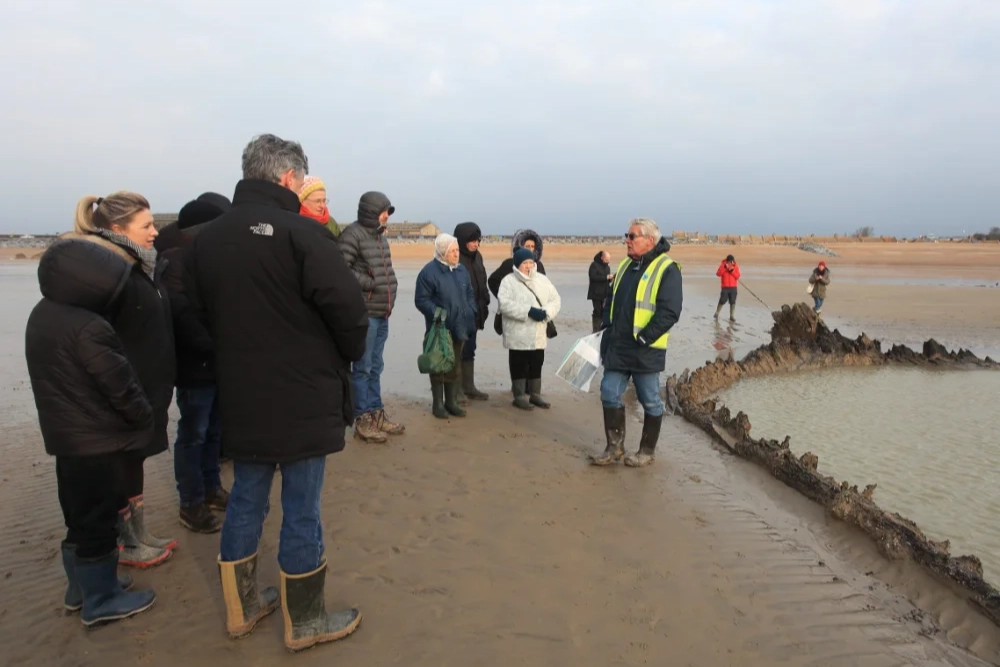

For well over two hundred years, during the 17th , 18th and 19th centuries, much of the world’s international trade was carried out by great sailing vessels, known as East Indiamen. These majestic ships, operated by huge companies, based not only in this country, but also in the Netherlands, Spain, France and Portugal amongst other places, opened up major trading routes across the world, not to mention helping to extend their nations’ influence in far-flung territories.
In time, new technologies, different requirements, trading conditions and so on brought about the end of the East Indiamen and they disappeared, leaving behind little more than romantic memories of that great age of sailing. However, more than memories survive along our local stretch of coast because, near Bulverhythe in St Leonards, there rests the most complete wreck anywhere in the world of one of these magnificent vessels – the Dutch East Indiaman, the Amsterdam. Between two thirds and three-quarters of the ship remains, making her more complete than the Mary Rose. She is, in every respect, an international nautical treasure and should rank far higher in the imposing list of Hastings and St Leonards superb heritage jewels. Yet, for many, she remains a hidden secret.
For the last two years, she has remained hidden from sight under a blanket of sand and shingle, the two-and-three-quarter centuries old remains of the Dutch East Indiaman, the Amsterdam, have finally emerged from hibernation and are once again partially visible on the beach at Bulverhythe.
As a result, the Shipwreck Museum is now able to resume its hugely popular guided tours to the wreck. These not only reveal the remarkable story of the vessel itself, but also explores the extraordinary geology of the surrounding area, including direct contact with 140 million year old rocks from the early Cretaceous period and examining perfectly preserved trees – not fossilised/petrified – from a 4000 year old Bronze Age forest. And who knows what fossils might turn up?!
Sunday March 22nd saw the second of this year’s Shipwreck Museum-led guided visits to see the wreck of the Dutch East Indiaman Amsterdam. After nearly two years almost completely hidden under a blanket of sand and shingle, the ship started to re-emerge a few weeks ago and the ‘unveiling’ has continued at a quite remarkable pace. Visitors were astonished at just how much of the vessel was now showing and even the guides remarked that they had not witnessed quite so much of the vessel for a very long time.
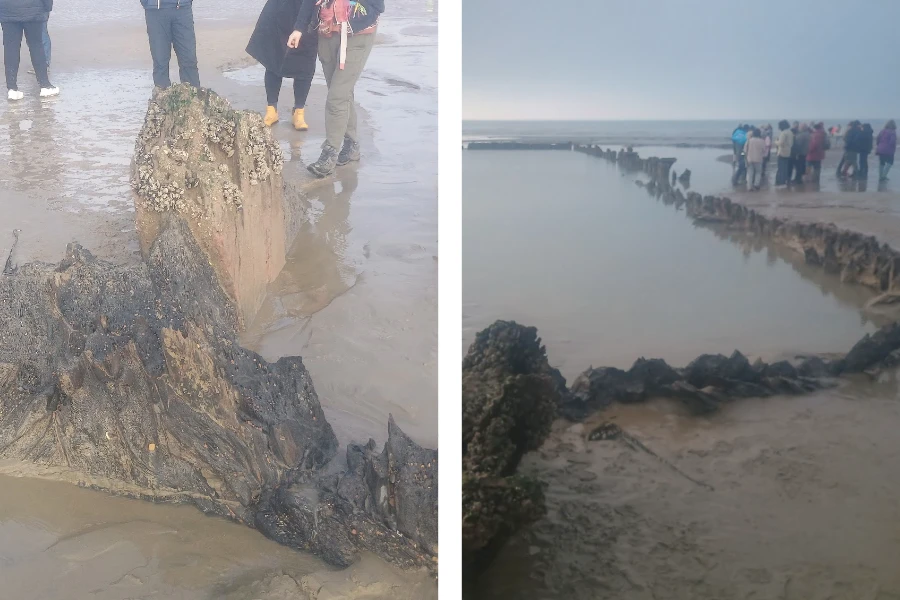
In addition, much of the perfectly preserved Bronze Age forest was in sight, enabling visitors to touch and feel the timbers as they would have felt when they were growing back in the time that Moses and Tutankhamun were here on earth! Also, great stretches of the 140 million year old Cretaceous rocks were clearly visible.
The next visit takes place on Sunday April 19, starting promptly at 07:10. Not surprisingly, bookings have already started to come in as it seems that the very large number of visitors who joined the visit on March 22 have spread the word around through social media that this is an event well worth attending.
It is strongly recommended that visitors don appropriate footwear, bearing in mind that it can be wet, slippery – and muddy. It is also suggested that provision be made for the fact that early mornings on Bulverhythe beach, whilst very pleasant, can also be a little on the chilly side!
Tickets are available for purchase in the Shipwreck Museum, either in person (open 10:30am – 4pm, but not Mondays and Thursdays) or by telephone on 01424 437452. You can also order them by e-mail info@shipwreckmuseum.co.uk. It is also possible to pay the walk leaders on the day itself, but this has to be by cash only. The cost of £6 for adults and £2 for children includes a copy of the fully-illustrated Amsterdam guidebook by Dr Peter Marsden, founder of the Museum and renowned expert on the wreck.